

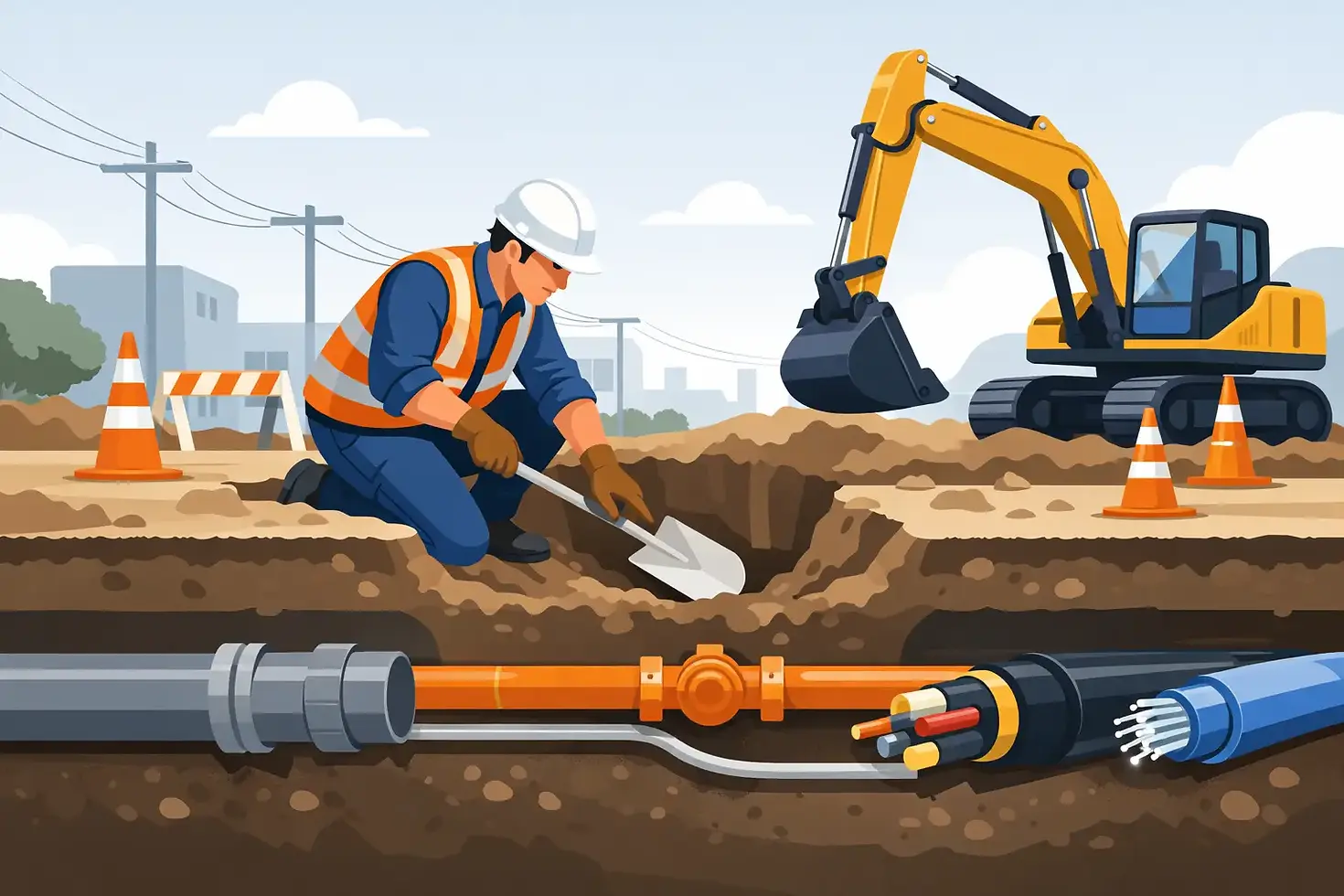
Excavation Around Existing Services Done Safely

A trench can look straightforward until the bucket finds a cable, water line or communications conduit that was never where the plans suggested. Excavation around existing services is one of the highest-risk parts of residential, commercial and light civil work, because the consequences of getting it wrong extend well beyond a delayed job. A damaged service can cause injury, disrupt a home or business, create expensive repairs and hold up every trade that follows.
Safe work starts before machinery arrives. It relies on accurate information, sensible site planning and an operator who knows when to stop digging and investigate. That is particularly relevant on established Coffs Coast and Mid North Coast properties, where older service routes, renovations and changing ground conditions can make the original layout hard to predict.
Why excavation around existing services needs a plan
Underground services are not always visible, accurately mapped or installed at a consistent depth. Plans and service location information provide a critical starting point, but they should never be treated as proof of an exact position. Private electrical cables, water pipes, irrigation lines, septic systems, drainage, NBN conduits and abandoned services may not appear on utility records at all.
This is where assumptions create risk. A homeowner may know roughly where the power enters the house, while a builder may have plans for a recent development. Both can still be missing later additions, diversions around trees or retaining walls, and private runs installed during previous works.
The right approach is to build a clear picture of the site first, then excavate in a way that gives the operator time and space to respond. It may feel slower at the beginning, but it prevents the far bigger cost of repairs, outages and rework later.
Start with locating, marking and confirming
Before excavation begins, available service information should be obtained and reviewed alongside the actual site. Utility plans, as-built drawings, previous electrical work and visible clues all help identify likely routes. Meter boxes, pits, poles, taps, inspection openings, pumps, air-conditioning units and outbuildings can point to services that cross the proposed work area.
On larger, older or more complex sites, specialist locating may be required. Electronic locating can identify many conductive services, while ground-penetrating methods and other techniques may assist in particular conditions. No method is perfect. Soil type, depth, congestion and the material of a pipe or conduit can affect the result, which is why identified routes need to be physically confirmed where excavation will occur.
That confirmation is commonly done through careful hand digging or non-destructive excavation, often called potholing. Small test holes expose the service so its location and depth can be checked without sending a machine bucket blindly through the area. Once confirmed, the service route can be clearly marked and the excavation plan adjusted if needed.
The excavation method should suit the service risk
A machine is efficient in open ground, but it is not the right tool for every centimetre of a trench. The closer the work gets to a known or suspected service, the more controlled the method needs to become. This is not a one-size-fits-all rule. The appropriate exclusion area and digging method depend on the service owner’s requirements, site conditions, available records and the type of asset involved.
A practical sequence often begins with machine excavation away from marked service corridors, followed by slower and more deliberate work as the trench approaches a risk area. Hand tools, insulated equipment where appropriate, spotters and carefully exposed test holes all play a role. The key is maintaining control, rather than trying to make up time with a larger bucket or faster movements.
For electrical work, the risk is especially serious. Underground cables may be live, damaged, poorly protected or installed in a route that does not match expectations. A cable strike can expose workers to electric shock or arc hazards, while damage that appears minor can later become a reliability or safety issue. If there is any uncertainty about an electrical service, work should stop until it is properly assessed.
Protect the people working around the trench
Service strikes are only one part of the risk. Open trenches introduce their own hazards, including unstable walls, falls, water ingress, plant movement and restricted access. Even a relatively shallow trench can become unsafe if the ground is loose, wet or undermined by existing pipes and conduits.
Good site control keeps plant, workers and property owners operating with clear boundaries. The operator needs a clean line of sight, the work area needs to be kept clear of unnecessary people, and a spotter can be valuable where visibility is restricted or services are close. Spoil should be placed where it will not load the trench edge or block access.
The conditions can change quickly after rain, particularly in coastal or sloping ground. Wet soil may slump, service trenches can fill with water, and machinery can lose traction. In those conditions, pausing, dewatering or changing the work method is not overcautious. It is sensible project control.
Coordinate electrical and excavation work from the start
When a project includes new power, lighting, communications or other underground runs, excavation and electrical work should be planned as one scope. Separating the trades without clear coordination can lead to trenches at the wrong depth, damaged conduits, unsuitable bends, insufficient cover or a trench being backfilled before inspection and testing are complete.
A coordinated contractor can establish the route, identify conflicts with existing services, excavate to the required profile, install suitable conduit and cable protection, then test and document the electrical work before backfilling. It reduces handovers and gives the client one point of contact when site conditions require a practical change.
This matters for future-proofing too. If access is already open, it may be worth considering spare conduits for a shed, pool equipment, gate, solar battery system, data connection or future landscaping power. There is a cost to including additional provision now, so it depends on the property and the client’s plans. But it is usually far easier to allow for future services before driveways, paths and gardens are finished.
What to do if a service is damaged
If a cable, pipe or conduit is struck, do not treat it as a quick repair job at the edge of a trench. Stop work immediately, keep people clear and isolate the area. Do not touch damaged electrical equipment, exposed conductors, the machine or surrounding ground if there is a possibility the cable is live.
The next step depends on the service involved. The relevant asset owner or emergency contact may need to be notified, and a licensed contractor should assess private electrical work. Water, gas and communications services each require their own response. Even where a service remains operational, visible damage should be dealt with before excavation resumes.
Trying to cover a damaged service and continue is a false economy. It can turn a contained repair into a later failure under a driveway, slab or landscaped area, when access is far more difficult and costly.
Choose capability, not just a machine
Hiring a machine or booking an excavation operator is only part of the decision. The value comes from the judgement behind the controls: reading the site, recognising warning signs, working to service information and communicating clearly when the ground does not match the plan.
For projects involving underground power or connected site works, GROUND. brings licensed electrical capability and precise excavation together. That means the trench is not simply dug and handed over. The route, protection, installation and safe completion can be considered as a single job from the start.
The best excavation work is often the work nobody notices once the project is finished. Services remain intact, new runs are protected, the site is restored properly and the next stage can proceed without a surprise buried beneath it.


Comments