

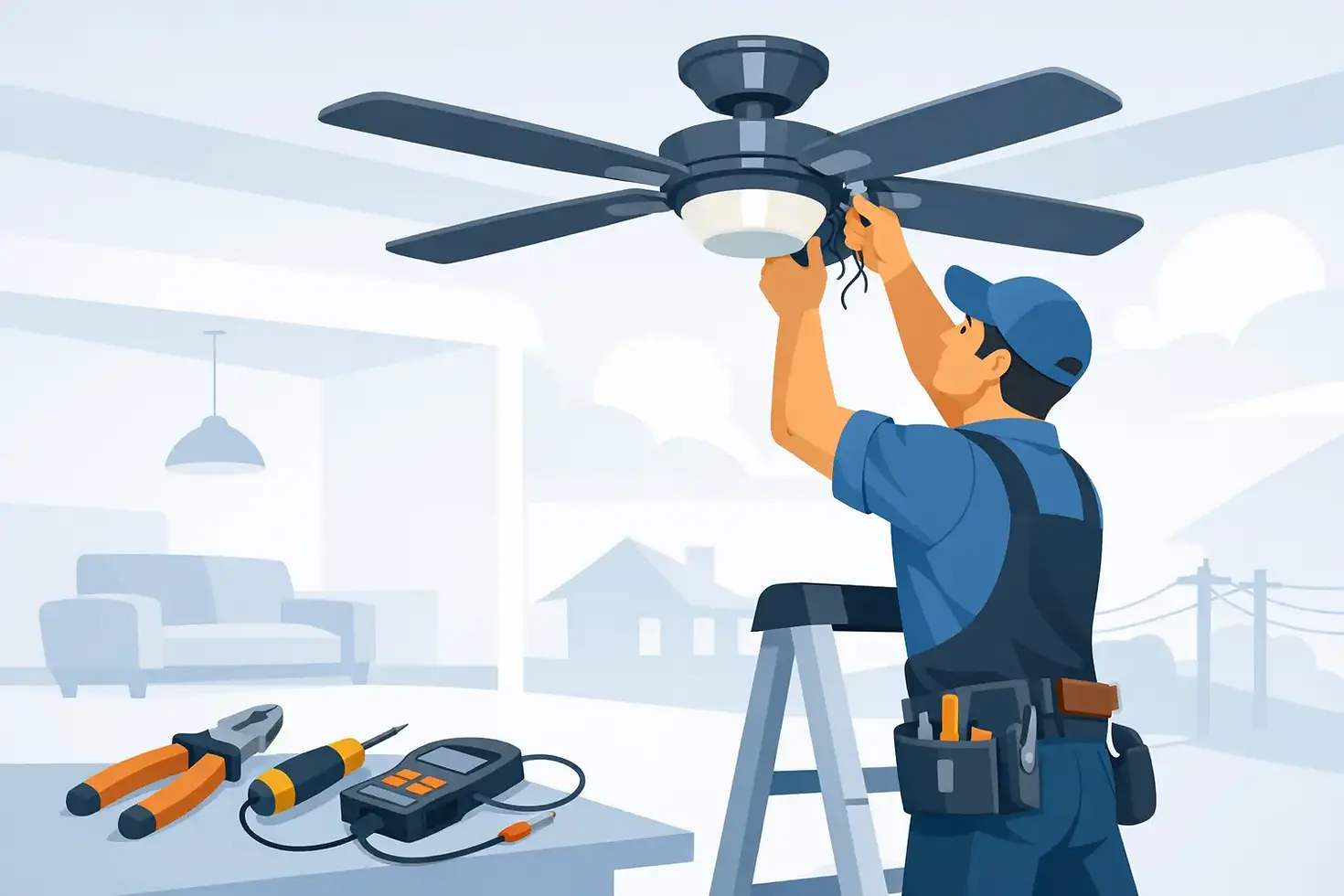
Ceiling Fan Installation Electrician Guide

A ceiling fan looks simple until you're standing under an old light fitting, staring at tired wiring and wondering what is actually sitting above the plaster. That is where a ceiling fan installation electrician earns their keep. It is not just about swapping one fitting for another. It is about making sure the fan is safely supported, correctly wired, compliant, and built to run properly through summer and beyond.
For homeowners across the Coffs Coast and Mid North Coast, ceiling fans are one of the most practical upgrades you can make. They help move air, take pressure off air conditioning, and make bedrooms, living areas and covered outdoor spaces more comfortable. But the quality of the install matters. A fan that wobbles, hums, trips circuits or is mounted to the wrong support is not a small issue. It is poor workmanship, and it can become a safety problem fast.
Why a ceiling fan installation electrician is the right choice
In NSW, electrical work needs to be carried out by a licensed electrician. That includes wiring a new ceiling fan, replacing a light with a fan, installing a wall controller, or sorting out faults that show up during the job. A licensed electrician is there to do more than connect wires. They check the existing circuit, confirm the switch wiring makes sense, test the final installation, and make sure the fan is legally and safely installed.
That matters even more in older homes. Plenty of houses around Coffs Harbour, Bellingen and Urunga have wiring that has been altered over time. You might have old switch loops, limited ceiling cavity access, brittle cable insulation or fittings that were never designed to carry the weight and movement of a fan. On paper, it sounds like a straightforward install. On site, it can be a different story.
A proper installation also protects the fan itself. Even a good-quality unit will underperform if it is mounted badly, poorly balanced or paired with the wrong control setup. The end result should be simple - solid mounting, clean operation, no unusual noise, and airflow where you need it.
What happens during ceiling fan installation
A good ceiling fan installation electrician will usually start with the basics - where the fan is going, what is already installed, and whether the existing wiring and structure can support the job. If there is already a light fitting in place, that does not automatically mean it is fan-ready. The electrical point may be usable, but the mounting point may still need work.
The electrician will check the support in the ceiling, the fan's clearance from walls and blades, and the switch arrangement. Some clients want a fan with an inbuilt light. Others want separate switching for the light and fan, a wall controller, or a remote. Each option affects how the install is set up.
In some homes, the job is clean and quick. In others, it needs additional cabling, a new switch wire, or minor fault-finding before installation can even begin. That is normal. Electrical work often depends on what is found once access is gained.
New fan installation versus replacement
Replacing an old fan with a similar new one is usually more straightforward than installing a fan where there has never been one before. Even then, there can be issues with ceiling condition, bracket compatibility or outdated wiring.
A brand-new installation generally takes more planning. If there is no existing point, the electrician may need to run new cable, install switching, and work through access limits in the roof space. If the room has concrete, cathedral ceilings or tricky framing, the approach can change again. This is why fixed pricing can depend on site conditions rather than just the fan model.
Indoor and outdoor fan installs
Not every fan suits every space. Bedrooms and living rooms have one set of requirements. Covered alfresco areas have another. Outdoor fans need to be rated correctly for the environment, especially in coastal areas where salt air and moisture can shorten the life of cheap or unsuitable fittings.
This is one of those areas where cutting corners costs more later. The right fan for the location, installed properly, will last longer and perform better.
Common issues a ceiling fan installation electrician spots
A lot of fan jobs uncover problems that were already there. The existing fitting might be hanging off a mounting point not designed for a moving load. The switch wiring might be confusing or non-standard. The circuit might already be carrying more than it should. In older properties, the ceiling cavity can also throw up surprises.
Some of the more common issues include inadequate support, damaged wiring, poor previous workmanship, and fan locations that do not meet clearance requirements. None of these are reasons to avoid the job. They are reasons to get it done properly.
A no-nonsense electrician will explain what has been found, what needs to be fixed, and whether it changes the scope or cost. That kind of communication matters. People do not like surprises on electrical work, and fair contractors know that.
How much does ceiling fan installation cost?
There is no single answer because the price depends on the job. A straightforward replacement in an accessible room costs less than a new install that needs extra wiring and switching. Fan type, ceiling height, roof access, controller options and the condition of existing wiring all affect the final figure.
What matters more than chasing the cheapest number is knowing what is included. Is the electrician supplying the fan or just installing it? Are they fitting a remote or wall controller? Is testing included? What happens if the existing wiring is not compliant or the mounting point is not suitable?
Transparent pricing is the standard to look for. A proper quote should reflect the real scope, not just the best-case scenario.
Choosing the right fan for the room
The right ceiling fan is not always the biggest or most expensive one. Room size, ceiling height and intended use all matter. A bedroom usually calls for quiet operation and reliable low-speed airflow. A large open-plan living area may need a bigger blade span or multiple fans. Covered outdoor spaces need fan models rated for the conditions.
There is also the control side. Remote-controlled fans are popular and convenient, but some clients still prefer a wall controller for simplicity and less clutter. If you want separate light and fan switching, mention that upfront. It is much easier to plan properly before the install than to change direction halfway through.
If you are renovating, this is also the time to think about future use. A fan installed in the right spot now can save rework later when layouts change or additional cooling becomes necessary.
Why workmanship matters more than speed
A fast install is fine if it is also done properly. The trouble starts when speed replaces care. Ceiling fans need secure mounting, correct balancing, safe terminations and proper testing. Rushed work often shows up as wobble, noise, unreliable controls or nuisance tripping.
For builders and renovators, reliable electrical work also keeps the wider project moving. A contractor who turns up on time, communicates clearly and solves site issues without drama saves time across the board. That practical, job-ready approach is what people are really paying for.
For homes and small commercial spaces, the same principle applies. A fan should not become an ongoing problem after installation. It should work properly from day one.
When to book a licensed electrician
If you are replacing a failed fan, upgrading from a standard light fitting, adding fans during a renovation, or fitting out a new extension or outdoor area, book a licensed electrician from the start. It is also worth calling one if your current fan hums, wobbles, stops responding to controls, or trips the circuit.
This is not work for guesswork or shortcuts. In many cases, what looks like a fan issue is actually a wiring issue, a support issue, or a problem with the switch setup. A licensed and insured contractor can identify the cause and fix it properly.
For local clients who want a straightforward outcome, GROUND. approaches this work the same way it approaches every job - clear advice, safe installation, solid workmanship and no mucking around. Whether it is a simple replacement or a more involved electrical upgrade, the aim is the same: get it done right the first time.
A ceiling fan should make a room more comfortable, not give you another thing to chase up. If the job is worth doing, it is worth doing safely, neatly and with the right sparkie on the tools.


Comments